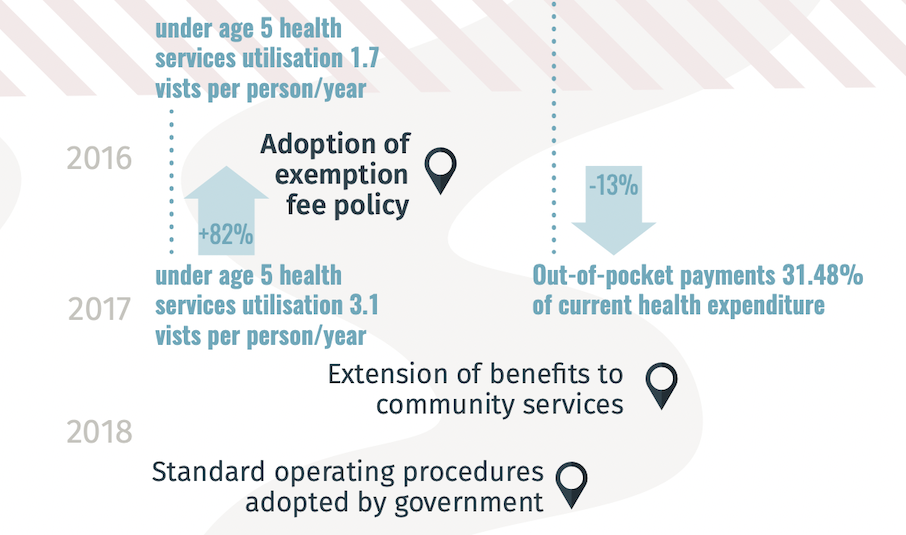
Burkina Faso has made striking progress towards UHC in the last decade. Catastrophic health expenditure decreased from 4.7% to 3.1%1; out-of-pocket payments fell from 36% to 31.48%2 of current health expenditure; neonatal mortality rate (NMR) decreased from 29.95% to 25.75%3, under-five mortality ratio (U5MR) from 121.5 to 84.99 per 1000 live births4, and maternal mortality ratio (MMR) from around 3605 to 3206 per 100 000 live births.
Burkina Faso’s progress in these areas reflects actions taken starting in 2012, when the government was eager to implement universal health insurance (UHI). Dialogue among policy makers in interrelated sectors was suboptimal, discussing trade-offs was challenging and progress was slow. In March 2012, Burkina Faso’s government requested the support of the P4H Network7, the global network for social health protection (SHP) and health financing (HF)8, whose coordination desk is based at the World Health Organization’s (WHO) headquarters.
The role of the P4H country focal person
From 2012 to 2020, a P4H country focal person (P4H-CFP) was deployed to WHO’s West Africa Intercountry Support Team as a regional HF policy adviser for UHC. With the P4H-CFP’s support, WHO facilitated collaboration among Burkina Faso’s Ministry of Health (MoH), Ministry of Public Services, Labor and Social Security and Ministry of Finance. Their joint work reflected evidence, international experiences, technical guidance and leadership skills sharing9. The support at policy level focused on the assessment of the country HF system and the development of a national HF strategy 10.
During and after the political transition in 2015, WHO also facilitated institutional development for UHI by supporting adoption of laws and decrees11. The P4H Leadership for UHC (L4UHC) programme12 simultaneously tackled adaptive challenges, with the L4UHC country team actively communicating about and advocating for UHC with the public, including the country’s highest authorities13. Last but not least, WHO and the P4H-CFP carried out their advisory role to the government in the implementation of the fee exemption scheme benefiting pregnant woman and children under five that was launched in 201614.
By 2020, high-level officials in Burkina Faso’s administration had taken actions to improve their technical capacity and address SHP challenges: an estimated 100 people benefited from WHO support in-country15. The country had in place a HF strategy for UHC (2018-2030)16, a law on UHI and an effective exemption fee mechanism for pregnant woman and children under five. An estimated 18.6% of the population (some four million people)17 now benefit from significant financial support in accessing health services, with more than 17 million free-of-charge health services delivered every year18.
The P4H Network’s added value lay in its capacity to facilitate intersectoral stakeholders’ dialogue for an extended period (eight years in this case). In its UHC journey, Burkina Faso has faced many additional challenges including security, climate change and pandemics. In this context, key factors of success include the permanency of policies and administration in-country, as well as the quality of interactions between high-level authorities, change agents and researchers. WHO has proved able to leverage support for this collaboration, relying on the P4H Network to provide personalized technical assistance, knowledge management services and support through the L4UHC programme.