In the first decade of the 2000s, world leaders revisited thinking about “health for all”, a goal of the World Health Organization since the early 1970s. This goal had already gained much attention and significance when, in 2000, the largest gathering of world leaders in history adopts the UN Millennium Declaration. In this broad context, in 2007 the Group of 8 embraces an initiative that will focus on health financing for universal health coverage – making health care affordable for all without financial hardship. This initiative will eventually become known as the P4H Network.
The Millennium Declaration – a milestone in global partnerships to reduce extreme poverty – gives rise to 189 countries adopting the Millennium Development Goals (MDGs), to be met by 2015. In that year, the United Nations Sustainable Development Goals (SDGs) pick up where the MDGs leave off, and 191 countries commit to universal health coverage targets. The SDGs include a focus on poverty reduction and recognize the connection between poverty and health. Poverty is seen as a major cause of poor health and poor health as a major cause of poverty. In particular, out-of-pocket health expenses strain household budgets when households must either pay health bills that cause them financial hardship or go without health care.
France and Germany center the foundational pillar of health for all in a series of global meetings and G8 summits in the first ten years of the 21st century. In this broad context, the G8 adopts an initiative that leads to the formation of the P4H Network.
In November 2004, Germany, the International Labour Organization, and the World Health Organization sign a letter of agreement to cooperate on social health protection and health financing with the aim of improving collaboration at country, regional and global levels. A consortium is created.
In December 2005, the consortium holds a conference in Berlin to share experiences in social health protection within the constraints of available resources. Following the conference, the consortium publishes a compilation of conference presentations on the experiences of developing countries on extending social protection in health.
On 16 March 2007, just months before the G8 summit in Heiligendamm, French President Jacques Chirac speaks at the International Conference on Financial Risk Protection in Case of Sickness in Developing Countries. For the June 2007 G8 summit focusing on Africa and the social dimension of globalization, President Chirac invites attendees to focus on three priorities.
- Create an international platform on health systems financing in poor countries.
- Agree that recommendations international partners make to fight poverty support the development of equitable health financing systems in countries they give aid.
- Provide financial support to countries committed to building equitable health financing systems and promote innovative financing.
- At the Heiligendamm summit, 6–8 June, the G8 endorses the Providing for Health (P4H) initiative “as a means to work toward sustainable and equitable financing of health systems and improved access to quality health services, through linking national financing strategies with coordinated international support”. The initiative, as described in a summit declaration, is envisaged as creating “an international forum for dialogue and collaboration on the financing of health systems in poor countries and on expanding initiatives of national and international donors to improve the efficiency of increasing national and international funding”.
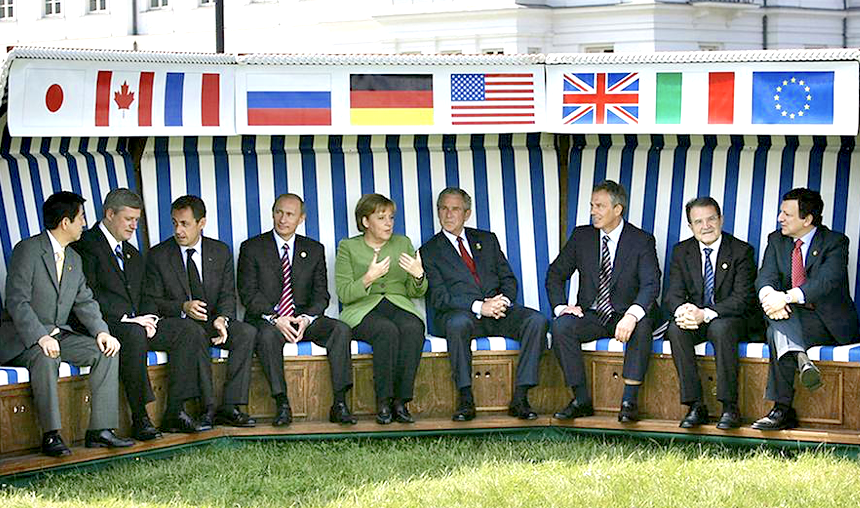
Heiligendamm, as well as the G8 summits that preceded and followed it – in Gleneagles (2005), St. Petersburg (2006), and Tōyako (2008) – reinforced the global public health agenda. At these summits, the G8 countries signed on to support strengthened health systems worldwide through social health protection for everyone and particularly for people living in poverty.
When in 2007 France and Germany launch Providing for Health (P4H) as a G8 initiative, membership is open to countries and multilateral agencies. The first members of the P4H Network are the World Bank Group, the World Health Organization, the International Labour Organization, France and Germany. In 2011, Switzerland and Spain join P4H, followed by the African Development Bank in 2012. In 2013, the United States of America becomes a member, represented by the United States Agency for International Development.
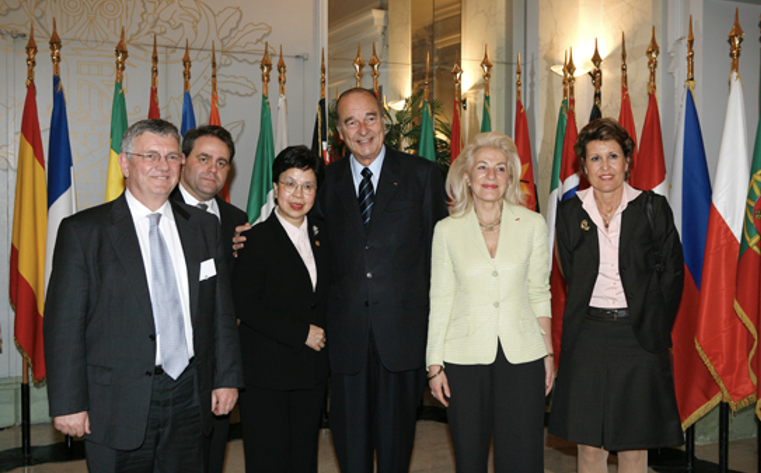
Pictured in 2007, left to right: Director-General of the International Labour Organization Guy Rider, Minister of Health and Solidarity Xavier Bertrand of France, Director-General of the World Health Organization Margaret Chan, President Jacques Chirac of France, French representative to the International Labour Organization Nicole Ameline and Minister of Development Cooperation Brigitte Girardin of France.